Interactive Results
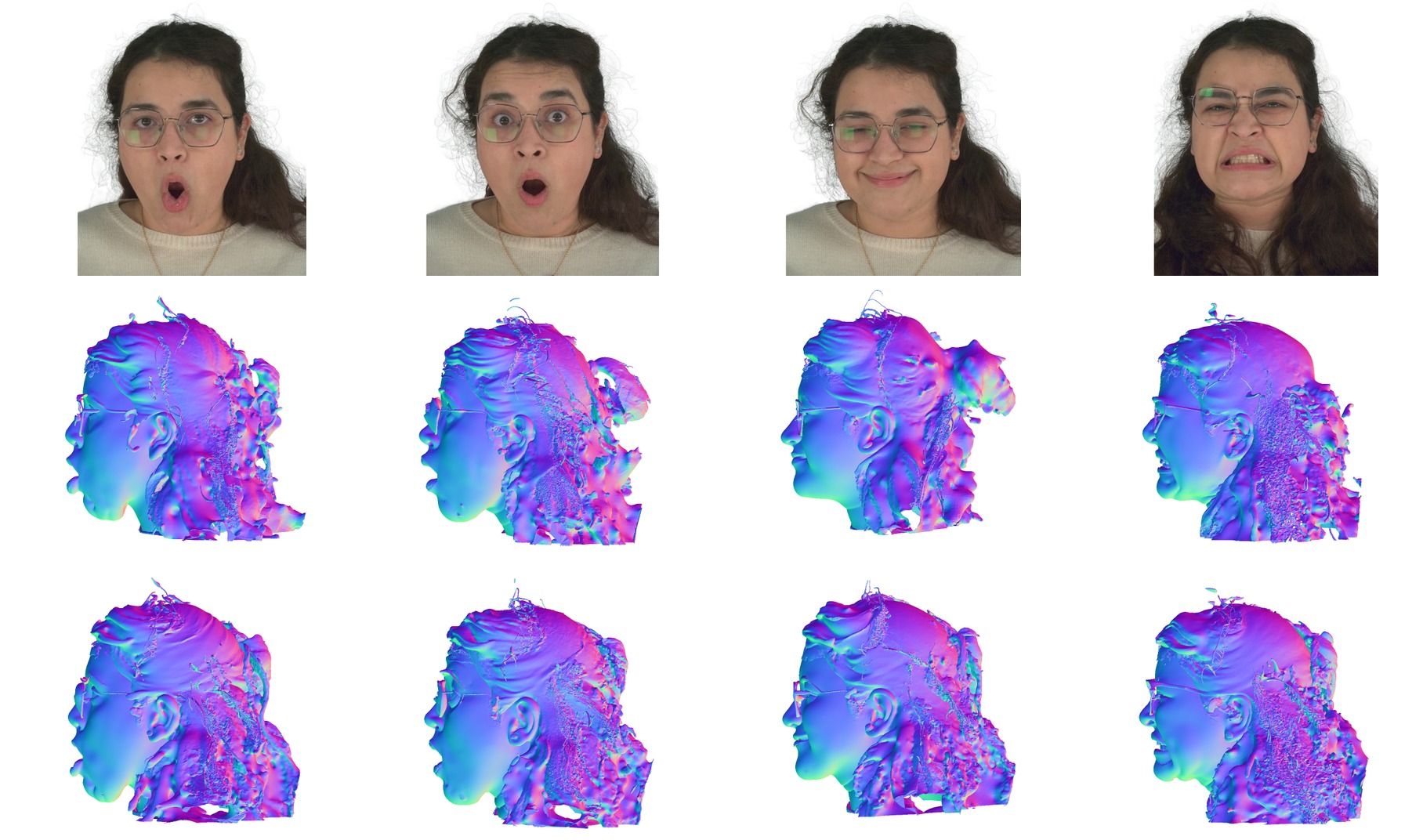
Four input images of a person (top) and the four meshes Head Anything generates jointly from them (bottom).
Drag to rotate, scroll to zoom. Choose an example above.
Results of Head Anything on real images.
Meshes generated from four input frames each, on in-the-wild videos and multi-view captures, textured with a separately fine-tuned texture model.
Interactive Results
Four input images of a person (top) and the four meshes Head Anything generates jointly from them (bottom).
Drag to rotate, scroll to zoom. Choose an example above.
Large image-to-3D generators recover detailed heads from a single photograph but treat every image as a new object. For several images of one person, they hallucinate unseen regions independently without using information from the other images. We present Head Anything, which generates detailed head meshes from a few images with changing expressions and viewpoints. Instead of training a multi-image prior, we turn a pretrained single-image generator with a native 3D latent space into a joint generator that denoises all images together. Since global attention between images is hard to learn from scarce 3D head data, lightweight correspondence-attention adapters let every 3D token attend only to its corresponding points in the other images. We obtain correspondences by fitting a neural parametric head model to the generator's own single-image outputs, requiring no ground truth at test time. Training on both ground-truth and fitted correspondences makes the adapters robust to fitting errors. Each mesh stays pixel-aligned with its own image and borrows the unseen regions from all others. On head scans, Head Anything lowers the head Chamfer distance of the best image-to-3D generator by 32% and its cross-frame inconsistency by 47%, and its meshes improve face tracking. Code and models will be released.
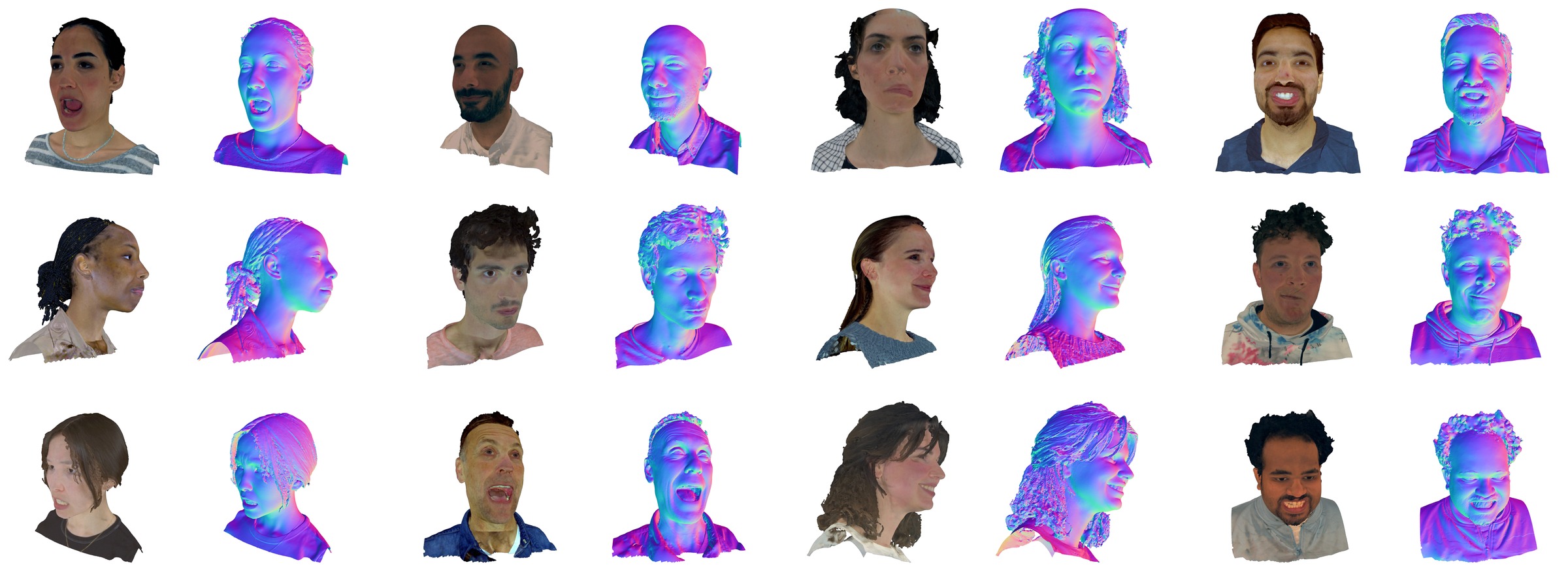
Dataset Examples
We fine-tune the single-image generator on photorealistic renders of NPHM head scans, and train the joint generator with the scans' registrations as ground-truth correspondences.
Mesh Generation Comparisons on Real Images
Parametric models recover plausible faces but represent hair as a smooth volume at best, while image-to-3D generators often miss the specific facial shape and produce noisy hair. Meshes are rendered with surface normal colours.
Mesh Error on Head Scans
Colours show the distance to the ground-truth scan. Head Anything lowers the head Chamfer distance of the best image-to-3D generator by 32% and its cross-frame inconsistency by 47%.
 ≥ 8 mm≥ 8 mm
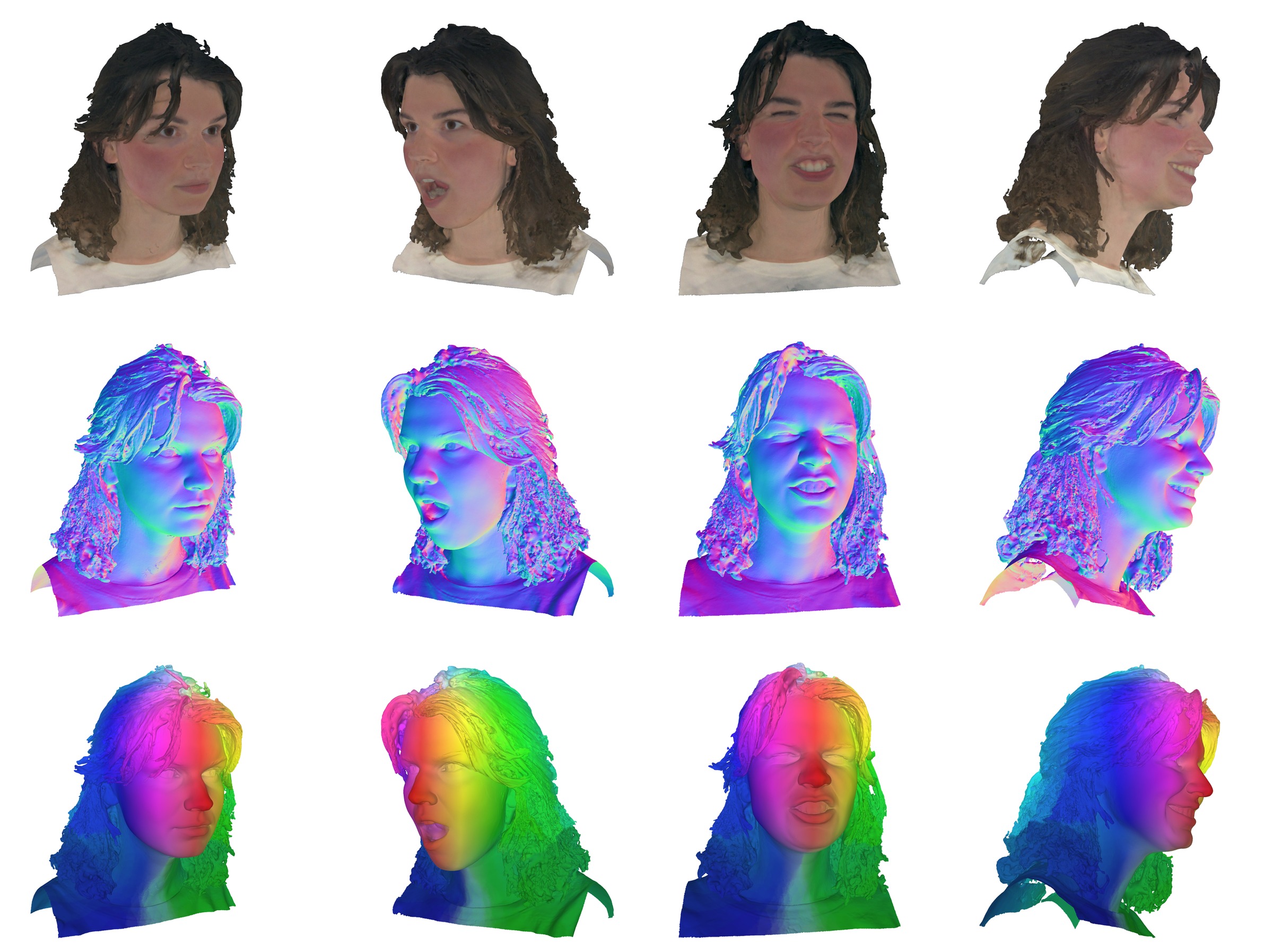
Back-of-Head Consistency
The back of the head is not visible in any input image. Generating each frame independently, Pixal3D-FT hallucinates a different hairstyle for every frame, while our meshes, denoised jointly and coupled at corresponding points, share one hairstyle (NeRSemble, side views).
More Images
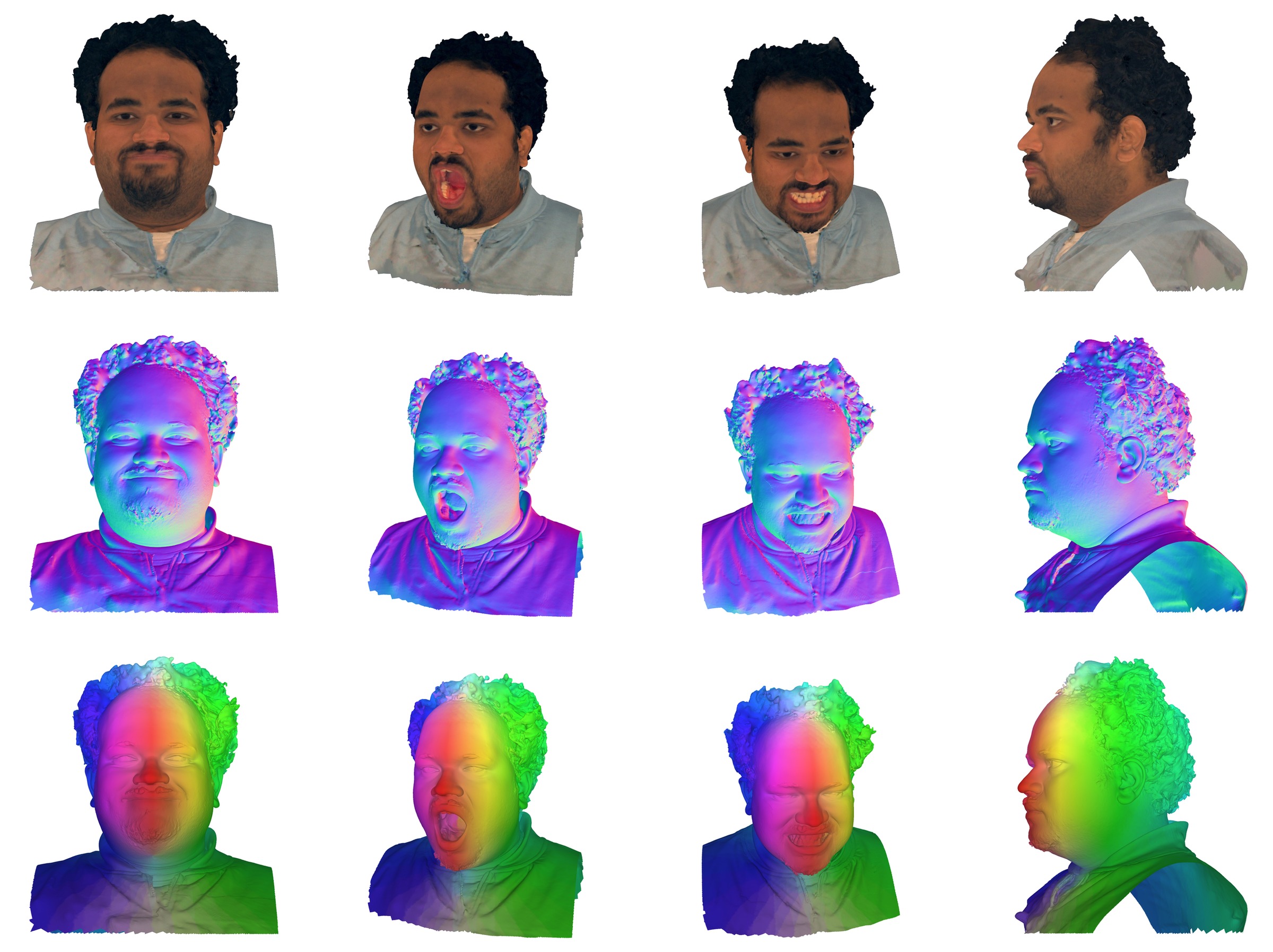
A target frame generated from one, two and four images of the same person, with fixed noise. The mesh becomes more accurate and complete as images are added (NPHM, colours show the distance to the GT scan).
≥ 8 mm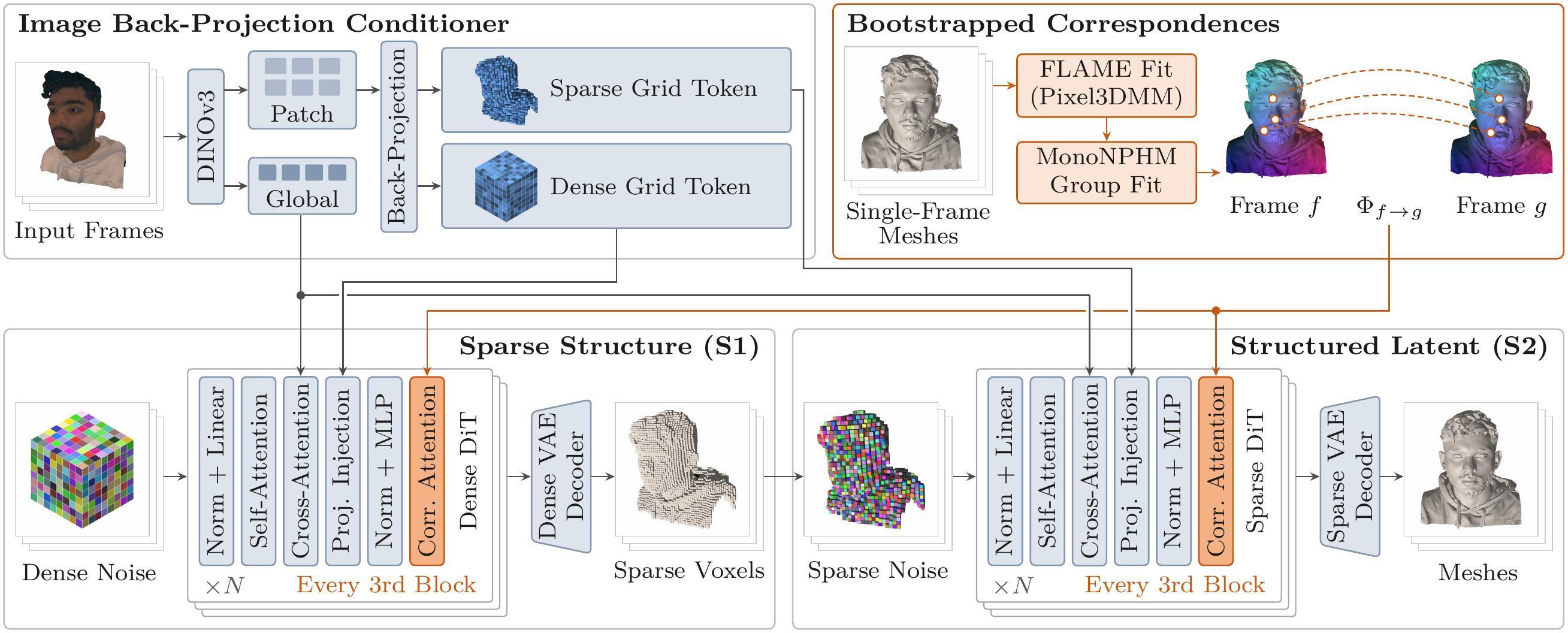
1. We build on Pixal3D, a pretrained single-image generator with a native 3D latent space. A sparse-structure flow (S1) decides the occupied voxels, and a structured-latent flow (S2) generates the detailed geometry on them.
2. We first fine-tune the generator on photorealistic renders of NPHM head scans, which gives a strong single-image head prior (Pixal3D-FT).
3. Each image conditions the generator through DINOv3 features. The patch tokens are back-projected onto the grid tokens, so every mesh stays pixel-aligned with its own image, and the global tokens enter through cross-attention.
4. All images are denoised jointly. Lightweight correspondence-attention adapters after every third transformer block couple the images at corresponding points, in both stages.
5. The correspondences are bootstrapped from the generator itself: we fit FLAME, initialised from Pixel3DMM, and then one MonoNPHM model to the single-image meshes of all images, so no ground truth is needed at test time.
6. Training on both ground-truth correspondences from the NPHM registrations and fitted correspondences makes the adapters robust to fitting errors.
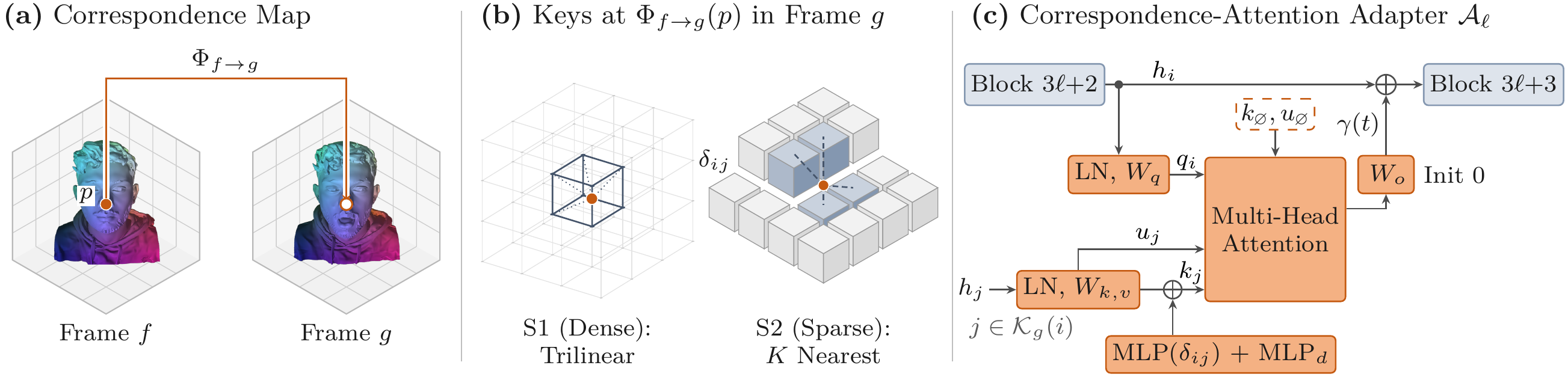
1. Global attention between images is hard to learn from a few hundred scanned identities. Instead, every 3D token attends only to its corresponding points in the other images.
2. A correspondence map $\Phi_{f\to g}$ maps a token position of image $f$ to its corresponding point in image $g$.
3. In the dense sparse-structure stage (S1), keys are sampled trilinearly at the corresponding point. In the sparse structured-latent stage (S2), keys come from the $K$ nearest occupied tokens, and their offsets and depths are embedded into the keys.
4. The adapter attends to these keys alongside a learned null key-value pair, so a token can ignore occluded or incorrect correspondences.
5. Its gated output is added to the residual stream through a zero-initialised projection, so training starts from the single-image generator and keeps its prior.
Base generator: Pixal3D, built on the design of TRELLIS and TRELLIS.2, with DINOv3 image features.
Image-to-3D generators: TripoSG, Hunyuan3D-2.1, and Direct3D-S2.
Parametric head models and trackers: FLAME, NPHM, MonoNPHM, Pixel3DMM, and VHAP.
Feed-forward 4D face reconstruction: Face Anything.
Datasets: NPHM, FaceVerse, NeRSemble, AVA-256, VFHQ, and CelebV-HQ.
Coming soon.